Connected or networked?
Trust. But in whom? Images, voices, and text can easily build a sense of closeness. But what happens when the person on the other end isn't who they claim to be?




Trust. But in whom? Images, voices, and text can easily build a sense of closeness. But what happens when the person on the other end isn't who they claim to be?
.jpg)

Imagine this: Someone messages you online. You like the same music. You play the same game. They listen, pay you compliments, and send photos or voice notes. Everything seems completely genuine.
How can you tell who is really behind it?
These days, a face doesn't have to belong to a real person.
Images, text, voices, and videos can be artificially generated or altered.
A digital identity can seem perfectly authentic, even if it’s entirely fabricated.
The crucial question, therefore, isn't just: Is this person real?
But also: Who can you talk to when something just doesn't feel right?
A real moment between a child and a caregiver. Photographed by Medina Kurtović.
We don't see their faces. Yet we feel closeness, comfort, and trust. The relationship is not staged. It has developed over time and provides security.
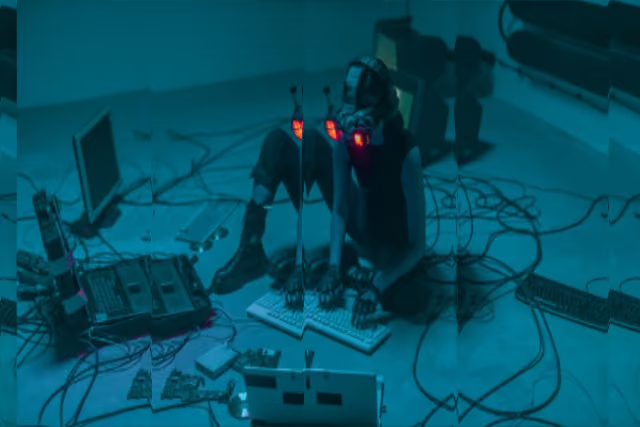
This image also conveys closeness. A supposed teenager is holding a teddy bear. They appear sensitive, caring, and familiar. But the person does not exist. They were created with AI by Basil Stücheli and could be part of a fabricated online identity.
Both images show closeness. But only one captures a real relationship.
These patterns are human and understandable. What matters is addressing them and viewing control as a supplement, not a substitute for your relationship with your child.

A time limit can be set and checked off. Building trust takes a long time and isn't visible at a glance, which is why we first reach for what seems easier to implement at first sight.

A filter acts like a final answer. The real question of how my child is actually doing online remains untouched.

Sometimes an app lock is also easier because talking about boundaries, feelings, or unpleasant online experiences is uncomfortable in itself.

The stricter the control, the more likely children are to switch to secondary accounts or secret usage; the abuse doesn't disappear, it just becomes invisible.
On average, it takes just 90 seconds for a child to be contacted by an adult for sexual purposes online. Protection doesn't come from monitoring, but from children knowing: no matter what happens, you can always come to me.

"What did you play today?" opens a conversation. "Show me your phone right now" shuts one down. Curiosity is more effective in the long run than control.

Children are more likely to talk about a strange contact or experience if they know they won't be punished for it, even if they have broken a rule.

You don't have to play along. Simply showing interest without judgment makes your child's digital space a place you are familiar with too.

Age ratings and time limits are useful. But they are no substitute for a conversation about what your child is experiencing online.
Kinderschutz Schweiz provides free and confidential advice to parents: 058 433 33 99 (Mon–Thu) or info@kinderschutz.ch. At clickandstop.ch, parents, caregivers, and those affected can find information on digital, sexualized violence: 058 433 33 50 (Mon–Fri) as well as via chat.
For children and teenagers themselves: 147 (Pro Juventute), available 24/7.

Around one-third of children and adolescents in Switzerland have already experienced cybergrooming. Perpetrators systematically build trust online over a long period with the goal of creating intimacy and emotional dependency.
(Source: Kinderschutz Schweiz)

Minecraft and Call of Duty were among the games where children were contacted most frequently. Cybergroomers specifically target online games and social media channels popular with children to establish contact.
(Source: Landesanstalt für Medien NRW, 2022.)
Around 85 percent of those affected by cyber sexual offenses are under 20 years old. In 2025, 4.7 percent of all police-registered crimes with a digital component involved cyber sexual offenses such as cyber-grooming, sextortion, or prohibited pornography.
(Source: Police Crime Statistics 2024, cited by Kinderschutz Schweiz.)
"What if the best protection isn't a filter, but an open ear?"
Welcome to WHAT THE FAKE – discover more image pairs, facts, and tips.
We would like to thank Kinderschutz Schweiz for their expert guidance on this image pair.